 EZGOGO
Conference Interpretation Vietnam: Essential Pre-Event Checklist
Planning an international conference in Vietnam? Professional conference interpretation Vietnam requires meticulous coordination beyond hiring skilled linguists. This guide walks you through essential pre-event steps—from technical equipment specifications to glossary preparation and interpreter briefing protocols—ensuring your multilingual sessions run seamlessly across Hanoi, Ho Chi Minh City, and Da Nang's expanding business venues.
Preparing Your Team for Multilingual Success
Vietnam's economy has grown into one of Asia's fastest-expanding markets, attracting multinational conferences to Hanoi, Ho Chi Minh City, and emerging hubs like Da Nang. Conference interpretation Vietnam has become critical infrastructure for international business summits, trade forums, and professional conventions in the region. Without proper pre-event coordination, even world-class interpreters cannot deliver the seamless communication your delegates expect.
The difference between a forgettable conference and a transformative one often hinges on how thoroughly you've prepared your interpretation infrastructure. This checklist distills best practices used by professional event organizers, venue managers, and interpreter coordinators across Vietnam's business landscape.
Why Pre-Event Planning Matters for Conference Interpretation
Simultaneous interpretation setup demands precision—technical glitches, unclear speaker pacing, and unfamiliar terminology derail even the most eloquent presentations. Vietnam hosts over 300 international conferences annually according to the Vietnam National Administration of Tourism, yet many organizers underestimate interpretation logistics. Investing four to six weeks in pre-event preparation prevents costly last-minute scrambling.
The Vietnamese Business Conference Landscape
Ho Chi Minh City and Hanoi now rank among Southeast Asia's top conference destinations, with major venues like the Saigon Convention and Exhibition Centre and Hanoi International Convention Centre regularly hosting 1,000+ delegate events. These spaces increasingly cater to multilingual programming, creating opportunities for professional conference interpretation services. Understanding local venue capabilities and vendor networks is essential for seamless event execution.
Question 1: What are the core technical requirements for simultaneous interpretation setup?
Simultaneous interpretation setup requires dedicated transmission systems (wireless or infrared), sound-isolated interpreter booths, individual receiver headsets for each language channel, and redundant backup equipment to prevent audio failures during critical sessions.
Interpretation Equipment Specifications
Conference interpretation Vietnam typically uses either digital wireless systems or infrared technology, depending on venue infrastructure and delegate density. Wireless systems suit open spaces and outdoor sessions; infrared works best in enclosed halls where signal containment matters. Request detailed technical specs from your audio-visual provider at least eight weeks before the event.
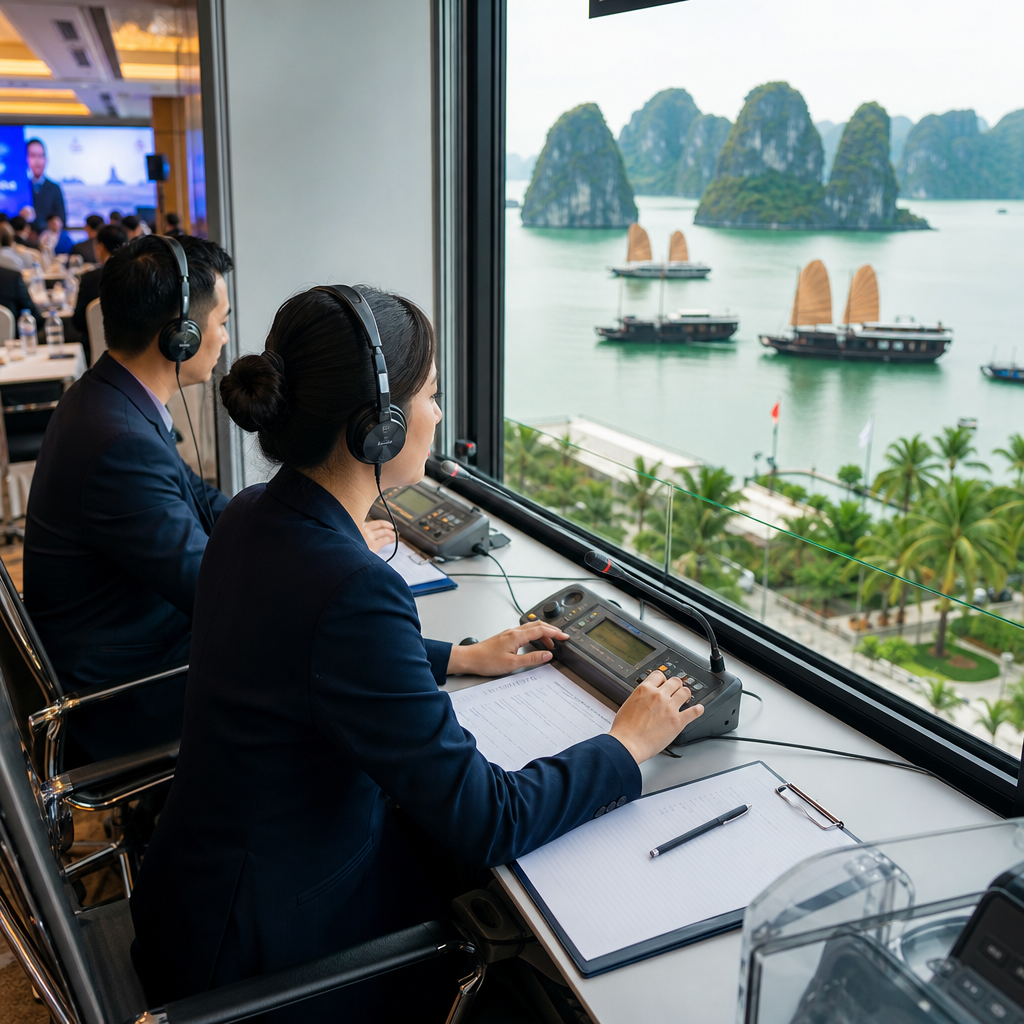
- Interpreter booths: Require soundproof enclosures with clear sightlines to the main podium and video screens showing speaker slides and monitor feeds.
- Headsets and receivers: Each delegate must have access to a dedicated receiver tuned to their language channel, with backup units for every 50 attendees.
- Cable and power management: Wireless systems need charging stations; infrared systems require clear line-of-sight between transmitters and audience zones.
Testing and Load Capacity
Vietnamese conference venues vary widely in technical sophistication. Conduct a full-scale audio test five days before the event, testing all language channels simultaneously with dummy loads (speakers in empty booths). Confirm that your interpretation equipment can handle peak attendance without signal degradation or cross-channel interference.
Question 2: How should you brief interpreters before a major conference?
Interpreter briefing should occur 48–72 hours before the event and include speaker introductions, presentation flow walkthroughs, cultural context on the audience, and review sessions for technical terminology specific to your industry or conference theme.
Pre-Event Briefing Sessions and Materials
Professional interpreters require more than a list of speakers and topics. Provide speaker videos or audio recordings, presentation slide decks (at minimum 10–14 days in advance), and a detailed run-of-show schedule. Allow interpreters to hear how speakers pronounce key names and terms, reducing real-time guesswork. This preparation dramatically improves accuracy and confidence during live sessions.
- Speaker profiles: Share biographical backgrounds, speaking style notes, accent characteristics, and any known speech patterns (rapid-fire delivery, use of humor, technical jargon density).
- Audience composition: Brief interpreters on delegate demographics, industry expertise levels, and whether audiences will include competing companies or sensitive stakeholder groups.
- Handover protocols: Confirm shift lengths for interpreters (typically 20–30 minutes for simultaneous interpretation to prevent cognitive fatigue) and rotation schedules across multiple language teams.
Industry-Specific Terminology Walkthroughs
Schedule dedicated glossary review sessions where interpreters drill sector-specific vocabulary with your subject matter experts. In Vietnam's manufacturing, logistics, and tech sectors, terminology often requires precise translation to avoid misunderstanding. Allow interpreters to ask clarifying questions about context and usage, not just vocabulary definitions.
Question 3: What documentation and glossaries must you prepare in advance?
Essential pre-event documentation includes a master glossary (4–6 weeks ahead), speaker bios, presentation slides, detailed agenda with timing, and a conference-specific terminology guide vetted by subject matter experts in your industry.
Building a Robust Conference Glossary
A professional conference interpretation glossary goes beyond a simple word list. It should include context-rich definitions, approved translations in each target language, and real-world usage examples pulled from industry reports or previous events. Share your glossary with interpreters at least 14 days before the event, allowing time for questions and refinements.
- Multi-column format: Organize glossaries with English term, definition, Vietnamese equivalent, alternative translations, and usage notes in a shared document accessible to all interpretation team members.
- Industry-specific sections: For conferences on trade policy, supply chain, or financial services, create separate sections devoted to sector terminology so interpreters can drill rapidly.
- Speaker-contributed terms: Request presentations from each keynote and panel speaker 20 days ahead; extract proprietary product names, acronyms, and internal terminology unique to their organization.
Slide Decks and Presentation Materials
Delayed or incomplete slide deck distribution forces interpreters to work without visual context on the day of the event. Request all presentation materials (slides, videos, handouts) no later than ten days before the conference. Interpreters need time to familiarize themselves with visual flow, data charts, and graphics that may reference terms unfamiliar to general audiences.
Question 4: How do you coordinate with local Vietnamese venues for interpretation services?
Coordinate early with Vietnam-based venues to confirm their interpretation infrastructure, available interpreter networks, audio-visual vendor partnerships, and cost structures for booth rental, equipment, and technical support staff.
Venue Coordination and Equipment Availability
Major venues in Hanoi and Ho Chi Minh City typically offer in-house interpretation coordination, but you must confirm availability and quality standards. Request references from previous international events, sample equipment lists, and clarity on who manages contingency support if systems fail during sessions. Vietnam's leading conference venues often partner with established interpretation service providers, which can streamline logistics.
- Booth rental and setup: Verify booth sizes, sound isolation quality, and technical connectivity (power, video feeds, monitor positions) at least six weeks before your event date.
- Interpreter vetting: Ask venues for lists of certified interpreters in your required language pairs; cross-check qualifications and prior conference experience directly.
- A/V partner relationships: Confirm whether your venue's preferred audio-visual vendor has worked on similar multilingual events and can provide redundant systems for mission-critical sessions.
Managing Interpreter Logistics and Payment
Coordinate payment terms, meal provisions, and accommodation (if your event spans multiple days) with your interpretation team at least four weeks ahead. Professional interpreters expect clear expectations about session timing, equipment readiness, and communication channels for real-time problem-solving. Establish a dedicated event-day contact who can reach interpreters within minutes if technical issues arise.
Question 5: What contingency plans protect against interpretation failures?
Contingency planning includes backup interpreters for each language, redundant audio equipment on standby, a simplified single-language fallback protocol if systems fail, and 24-hour vendor support on the day of your conference.
Backup Interpreter Networks and Equipment
Identify and contract backup interpreters for each language channel—ideally from a second interpretation agency—before the event. Similarly, work with your A/V vendor to ensure they have backup wireless transmitters, interpreter headsets, and power supplies available on-site. In Vietnam's rainy season (May–September), power and equipment failures happen; redundancy prevents crisis scenarios.
- Secondary interpreter roster: Brief backup interpreters on glossaries and speaker materials so they can step in with minimal notice if a primary interpreter becomes ill or unable to perform.
- Equipment failover procedures: Document step-by-step protocols for switching from primary to backup wireless systems, including time required and spokesperson announcements needed.
- Communication chain: Designate a central event coordinator who coordinates between venue management, A/V vendor, interpretation team lead, and conference organizers—all reachable by phone during the event.
Crisis Communication and Recovery Messaging
If technical failures occur despite planning, transparency and quick recovery matter more than pretending everything is fine. Brief your master of ceremonies and session chairs on simple, calm messaging that explains brief technical pauses without alarming delegates. Prepare brief contingency slides (in all languages) explaining temporary system transitions to buy time while technical teams resolve issues.
Conclusion
Conference interpretation Vietnam success depends on meticulous preparation across six dimensions: technical equipment specs, interpreter briefing depth, glossary completeness, venue coordination, documentation timeliness, and contingency readiness. International organizers who invest 4–6 weeks in these steps consistently report smoother events, higher delegate satisfaction, and fewer last-minute crises. The cost of preparation pales against the reputational damage and lost content quality that poor interpretation causes.
As you plan your next multilingual business event in Vietnam, remember that professional interpreters are only half the solution—your infrastructure, materials, and coordination are equally critical. For international teams seeking on-ground support during conference preparation or execution, ezgogo.app connects you with experienced interpreter-companions familiar with Vietnam's major venues and business culture, ensuring your event unfolds flawlessly.
Sources
- Vietnam National Administration of Tourism — Annual Conference Statistics
- Vietnam Briefing — Vietnam Ranks Among Asia's Top Conference Destinations
- Reuters — Vietnam's Economic Growth and International Business Expansion
- General Statistics Office of Vietnam — Business and Trade Data
- Vietnam Investment Review — International Event and Venue Infrastructure
Frequently Asked Questions
Question 1: What are the core technical requirements for simultaneous interpretation setup?
Simultaneous interpretation setup requires dedicated transmission systems (wireless or infrared), sound-isolated interpreter booths, individual receiver headsets for each language channel, and redundant backup equipment to prevent audio failures during critical sessions.
Question 2: How should you brief interpreters before a major conference?
Interpreter briefing should occur 48–72 hours before the event and include speaker introductions, presentation flow walkthroughs, cultural context on the audience, and review sessions for technical terminology specific to your industry or conference theme.
Question 3: What documentation and glossaries must you prepare in advance?
Essential pre-event documentation includes a master glossary (4–6 weeks ahead), speaker bios, presentation slides, detailed agenda with timing, and a conference-specific terminology guide vetted by subject matter experts in your industry.
Question 4: How do you coordinate with local Vietnamese venues for interpretation services?
Coordinate early with Vietnam-based venues to confirm their interpretation infrastructure, available interpreter networks, audio-visual vendor partnerships, and cost structures for booth rental, equipment, and technical support staff.
Question 5: What contingency plans protect against interpretation failures?
Contingency planning includes backup interpreters for each language, redundant audio equipment on standby, a simplified single-language fallback protocol if systems fail, and 24-hour vendor support on the day of your conference.
Need a local companion or interpreter in Vietnam?
Browse verified companions for language support, factory visits, and authentic local experiences.
Find a Companion →