 EZGOGO
Conference Interpreting Vietnam Preparation: Complete Technical Guide
Hosting a multilingual conference in Vietnam requires meticulous planning beyond hiring skilled interpreters. This guide covers the essential technical infrastructure, equipment specifications, speaker briefing protocols, and logistical coordination needed for seamless conference interpreting Vietnam preparation. From simultaneous interpretation booths to audio-visual integration, learn how to prevent costly delays and ensure every participant—regardless of language—receives crystal-clear delivery.
Building a Flawless Foundation for Conference Interpretation
Vietnam's position as a regional business and technology hub has driven explosive growth in international conferences, trade forums, and multinational corporate events. According to the General Statistics Office of Vietnam, the country hosted over 1,200 international conferences in 2022, with double-digit annual growth in foreign participant attendance across Hanoi, Ho Chi Minh City, and Da Nang.
Conference interpreting Vietnam preparation demands far more than selecting fluent speakers. Technical infrastructure, equipment calibration, speaker coordination, and contingency planning form the backbone of successful multilingual events. Poor preparation leads to feedback loops, audio dropouts, interpreter fatigue, and audience frustration—outcomes that damage corporate reputations and jeopardize business outcomes.
Why Technical Precision Matters in Vietnam's Growing Conference Sector
Vietnam attracts investment-focused conferences, manufacturing symposiums, and technology summits where precision communication is non-negotiable. A single misinterpretation of regulatory language or technical specification can derail contract negotiations or result in compliance violations. Proper conference interpreting Vietnam preparation eliminates these risks.
This Guide's Scope: From Equipment Specs to Day-Of Execution
We walk through simultaneous interpretation setup requirements, interpreter briefing materials organization, venue technical considerations, speaker coordination protocols, and backup contingencies. Whether your event spans one day or five, this checklist ensures nothing falls through the cracks.
Question 1: What are the core technical equipment requirements for simultaneous interpretation?
Simultaneous interpretation requires a complete audio infrastructure: interpreter consoles with microphones and headsets, soundproof booths, a central mixing system, receiver units for audience members, and backup power supplies rated for your event duration and booth count.
Interpretation Console and Booth Specifications
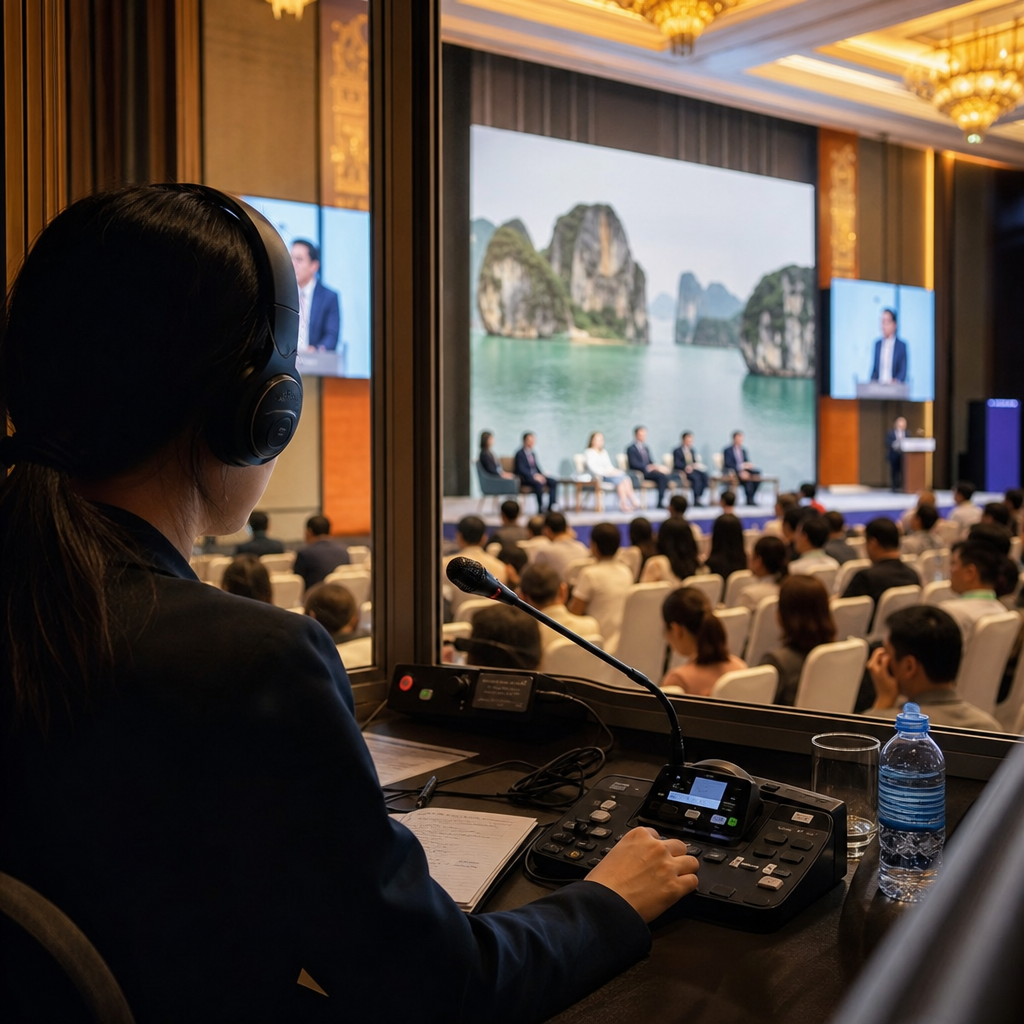
Each interpreter booth must house a dual-channel mixing console with independent volume controls, a professional-grade condenser microphone, closed-back monitoring headphones, and a comfortable ergonomic chair. Booths should be constructed from acoustic foam or modular soundproof panels rated for 40+ dB noise reduction. Glass panels enable sight lines to the main stage.
- Booth dimensions: Minimum 1.5m × 1.2m interior space per interpreter to prevent fatigue and ensure proper microphone positioning.
- Microphone type: Cardioid condenser mics (e.g., Audio-Technica AT2020 or equivalent) with pop filters to eliminate breath noise.
- Monitoring headsets: Closed-back professional headsets (e.g., Sennheiser PMX 686) with adjustable volume and mute switches for coordinator communication.
Central Audio Infrastructure and Distribution
A professional mixing console sits at the core—typically a 16- to 32-channel digital mixer (e.g., Behringer X32, Soundcraft Si Impact) that routes interpreter feeds to individual language-specific receiver channels. Each participant receives a wireless or wired receiver unit tuned to their language channel. UPS battery backup systems must support at least two hours of continuous operation.
- Wireless receiver systems: Professional IR (infrared) or RF (radio frequency) systems with 500+ simultaneous receivers per language; IR requires clear line-of-sight, while RF penetrates through walls.
- Cable redundancy: Run primary and backup audio cables through separate conduit routes to prevent single-point failure from physical damage.
- Power backup: UPS units sized to 150% of total system wattage, tested 48 hours before the event.
Question 2: How should speaker materials and briefing documents be organized before the event?
Interpreter briefing materials must be compiled and delivered 7–10 days before the conference; include speaker abstracts, presentation slides, glossaries of technical terms, organizational charts, and speaker pronunciation guides organized by session and language pair.
Creating Comprehensive Interpreter Briefing Packs
Each interpreter working a conference needs sector-specific vocabulary lists. For manufacturing conferences, glossaries covering industrial equipment, quality standards, and supply-chain terminology are essential. For investment forums, financial instruments, regulatory frameworks, and tax terminology must be clarified. Digital PDF packs organized by speaker name and session reduce prep time and ensure consistency across interpreters.
- Terminology glossaries: Bilingual lists (English-Vietnamese, English-Mandarin, etc.) with phonetic spelling for difficult names and acronyms.
- Speaker bios: Background on each presenter including pronunciation of their name, company affiliations, and key expertise areas.
- Presentation slides: Full slide decks in advance, allowing interpreters to familiarize themselves with visuals and anticipate speaker flow.
Timing and Delivery of Briefing Materials
Materials should arrive to interpreters no later than one week before the event, allowing 20–30 hours of preparation per interpreter. For complex technical conferences, schedule a pre-conference online briefing session where speakers answer interpreter questions and discuss pronunciation expectations. This is particularly important for Vietnamese speakers with international names or unfamiliar technical domains.
- Material format: PDF files organized in a single shared folder (Google Drive or Dropbox) with clear naming conventions (e.g., "Session_01_Speaker_Chen_Presentation.pdf").
- Glossary updates: Notify interpreters immediately of any last-minute speaker changes or terminology corrections discovered during final rehearsals.
- Pre-event coordinator call: A 60-minute video call with all interpreters, speakers, and event organizers two days before the conference.
Question 3: What venue considerations ensure optimal audio quality and interpreter comfort?
Venues must offer dedicated quiet rooms for interpreter booths, isolated from background noise and HVAC rumble; reliable power distribution to all technical stations; and sight lines from booths to the main stage, with stage monitors displaying speaker slides and speaker faces for lip-reading support.
Booth Placement and Acoustic Environment
Interpretation booths should be positioned at the rear or side of the main auditorium, elevated slightly above audience level to provide clear sightlines to speakers and visual aids. Avoid placement near doors, kitchen areas, or outdoor terraces where environmental noise (traffic, construction, weather) bleeds into microphones. Test audio levels 24 hours before the event in actual booth locations.
- Distance from stage: Position booths no more than 30 meters from the primary speaker stage to minimize sound delay and lip-sync issues.
- HVAC isolation: Confirm air-conditioning systems can be adjusted or muted during peak interpretation sessions to eliminate background rumble.
- Interior surfaces: Install acoustic paneling on booth walls and ceilings to reduce echo and external noise penetration.
Stage Monitoring and Speaker Visibility
Two high-definition monitors positioned inside each interpretation booth should display the speaker's live video feed and current presentation slides. This dual-feed setup allows interpreters to catch visual cues, speaker emotion, and slide-specific information without averting their gaze from the audience-facing microphone. Test monitor brightness and resolution in the actual booth lighting conditions.
- Monitor specifications: 21.5-inch or larger Full HD (1920×1080) displays with HDMI input; position at eye level to prevent neck strain during multi-hour interpretation sessions.
- Dual-feed routing: Use a video switcher to automatically overlay slide content and speaker video, or run separate cables to each monitor.
- Screen real estate: For multi-speaker sessions, add a third small monitor showing a running schedule and next speaker information to help interpreters transition smoothly.
Question 4: How do you coordinate with speakers to minimize misunderstandings during live interpretation?
Conduct formal speaker briefings two days before the event covering interpretation protocols, slide advancement coordination, microphone techniques, and speaker pacing; designate an event coordinator as the point of contact for real-time communication with interpreters, and establish hand signals or headset channels for seamless coordination.
Pre-Conference Speaker Training Sessions
Many Vietnamese business leaders and international speakers are unfamiliar with simultaneous interpretation dynamics. A structured 30-minute speaker briefing explains that interpreters cannot summarize or paraphrase—they must interpret every word faithfully. Speakers must pause every 2–3 sentences to allow interpreters to complete their rendering. Rapid-fire delivery, colloquialisms, and off-script remarks create interpreter anxiety and reduce accuracy.
- Pacing guidelines: Instruct speakers to maintain 100–120 words per minute, with natural pauses after every 30-40 seconds of continuous speech.
- Slide advance protocol: Provide speakers with slide-advance clickers and remind them to pause before advancing to allow interpreters to complete the previous thought.
- Pronunciation guidance: Conduct a phonetic run-through of technical terms, company names, and product acronyms that interpreters flagged during briefing prep.
Real-Time Coordination and Contingency Communication
Assign a dedicated event coordinator with a headset linked to all interpreter booths. This person monitors interpretation quality, communicates speaker changes or delays, and troubleshoots technical issues without interrupting the main auditorium. Develop a simple hand-signal system (thumbs up for clear understanding, raised hand for clarification request) visible to speakers from booth camera monitors.
- Coordinator role: One person with a Bluetooth headset connected to the central audio mixer, positioned at the side of the stage or in the technical control room.
- Speaker feedback loop: The coordinator relays interpreter cues to speakers in real-time (e.g., "Slow down slightly for the next section") via discreet ear monitor or hand signals.
- Language-specific channels: Assign each interpreter pair its own closed audio channel so they can communicate with the coordinator without audience broadcast.
Question 5: What contingency protocols protect against technical failures mid-conference?
Maintain redundant audio feeds for every critical component, keep backup interpreters on standby for each language pair, test all equipment for two hours before doors open, document system configurations and troubleshooting procedures in a printed manual, and conduct a mock-failure drill with all technical staff 48 hours before the event.
Equipment Redundancy and Backup Systems
A single console failure or microphone malfunction can silence an entire language channel. Professional conference venues in Hanoi and Ho Chi Minh City implement full N+1 redundancy: a second mixing console configured identically to the primary unit, a backup set of interpreter microphones and headsets, and redundant wireless receiver transmitters for each language. All backup systems must be powered and tested continuously throughout the event.
- Dual consoles: Configure a secondary mixer as a hot standby, with both units receiving identical inputs; a single button press switches audience/speaker feeds to the backup console.
- Backup microphones: Station a second set of condenser mics and XLR cables at each booth, tested and ready for immediate swap-out if primary equipment fails.
- Receiver redundancy: Deploy backup wireless transmitters for all language pairs, ensuring audience members can switch channels if signal drops.
Interpreter Coverage and Contingency Scheduling
Fatigue, illness, or personal emergencies can remove interpreters mid-event. Hire one additional interpreter per language pair as a standby, briefed on all materials and positioned in the venue. For multi-day conferences, schedule interpreters in 2-hour maximum rotation blocks, with 20-minute rest breaks between sessions to prevent cognitive fatigue that degrades interpretation quality. ezgogo.app can help you source and coordinate backup professional interpreters across Vietnam's major business cities.
- Standby interpreter brief: The backup interpreter attends all pre-conference briefings and receives identical materials, positioned in a monitor-equipped ready room adjacent to the main booth area.
- Rotation limits: No interpreter should work more than 6 consecutive hours without a 2-hour break; for full-day events, assign two interpreters per language who alternate every 2 hours.
- Health contingency: Request that interpreters notify the event coordinator immediately if they feel unwell during the event so substitutes can be deployed with minimal delay.
Equipment Testing and Documentation Protocols
Conduct a full technical rehearsal 24–48 hours before the event, testing all microphones, consoles, monitors, wireless receivers, and backup systems under full load. Create a laminated troubleshooting guide documenting console input/output assignments, wireless channel frequencies, monitor HDMI routing, and contact numbers for equipment rental company technicians. Keep this manual at the technical control station and in the hands of the event coordinator.
- Pre-event checklist: A printed checklist signed off by the technical director confirming all equipment tested, all interpreters briefed, all backup systems operational.
- Troubleshooting manual: Laminated reference cards at the mixing console and each interpreter booth documenting common issues (feedback, audio dropout, receiver malfunction) and resolution steps.
- Technician on-site: Retain a professional audio technician from the equipment rental company throughout the entire event; they should be on-site 30 minutes before start time and remain until all equipment is packed.
Conclusion
Successful conference interpreting Vietnam preparation integrates technical rigor, speaker coordination, and contingency planning into a single cohesive system. From soundproof booth specifications to backup power supplies, every detail compounds to create a professional experience that reflects positively on your organization and ensures no message gets lost in translation. The investment in proper conference interpreting Vietnam setup prevents costly misunderstandings and builds trust with international participants.
If you're organizing a multilingual conference in Vietnam and need to source skilled professional interpreters familiar with technical venue coordination and last-minute contingencies, explore ezgogo.app to connect with experienced interpreter-companions across Hanoi, Ho Chi Minh City, and Da Nang who understand both the technical demands and cultural nuances of Vietnam's growing business conference sector.
Sources
- General Statistics Office of Vietnam — International Conference Statistics 2022
- Vietnam Briefing — Vietnam Hosting Record Number of International Conferences
- Vietnam Investment Review — Business Event Coverage and Market Analysis
- VnExpress Business — Corporate Events and Conference Industry News
- Reuters — Vietnam Business and Trade Reporting
- Sennheiser — PMX 686 Professional Closed-Back Headset Specifications
Frequently Asked Questions
Question 1: What are the core technical equipment requirements for simultaneous interpretation?
Simultaneous interpretation requires a complete audio infrastructure: interpreter consoles with microphones and headsets, soundproof booths, a central mixing system, receiver units for audience members, and backup power supplies rated for your event duration and booth count.
Question 2: How should speaker materials and briefing documents be organized before the event?
Interpreter briefing materials must be compiled and delivered 7–10 days before the conference; include speaker abstracts, presentation slides, glossaries of technical terms, organizational charts, and speaker pronunciation guides organized by session and language pair.
Question 3: What venue considerations ensure optimal audio quality and interpreter comfort?
Venues must offer dedicated quiet rooms for interpreter booths, isolated from background noise and HVAC rumble; reliable power distribution to all technical stations; and sight lines from booths to the main stage, with stage monitors displaying speaker slides and speaker faces for lip-reading support.
Question 4: How do you coordinate with speakers to minimize misunderstandings during live interpretation?
Conduct formal speaker briefings two days before the event covering interpretation protocols, slide advancement coordination, microphone techniques, and speaker pacing; designate an event coordinator as the point of contact for real-time communication with interpreters, and establish hand signals or headset channels for seamless coordination.
Question 5: What contingency protocols protect against technical failures mid-conference?
Maintain redundant audio feeds for every critical component, keep backup interpreters on standby for each language pair, test all equipment for two hours before doors open, document system configurations and troubleshooting procedures in a printed manual, and conduct a mock-failure drill with all technical staff 48 hours before the event.
Need a local companion or interpreter in Vietnam?
Browse verified companions for language support, factory visits, and authentic local experiences.
Find a Companion →