 EZGOGO
Factory Interpreter Vietnam: Clear Communication on Site Visits
A noisy production floor can turn a promising supplier meeting into a series of missed questions and uncertain follow-ups. This client review shows how a factory interpreter Vietnam supported a fast-moving manufacturing visit, helping foreign visitors communicate with local teams, clarify technical details, and confirm next steps before leaving the site. The story also reflects Vietnam’s expanding role in regional manufacturing and trade. Read what effective interpretation changed during the visit and learn how professional language support can make business travel more focused, practical, and productive.
Communication Under Production Pressure
Vietnam has become an important manufacturing base in Southeast Asia, supported by electronics, machinery, textiles, furniture, and export-oriented supply chains. The General Statistics Office reported that processing and manufacturing remained a major contributor to industrial activity in 2024, while foreign-invested businesses continued to play a substantial role in exports.
Against this backdrop, factory visits are often more than introductory tours. Buyers, engineers, and operations managers may need to assess equipment, quality procedures, production capacity, and delivery expectations in a single afternoon. A factory interpreter Vietnam can help turn rapid conversations into accurate, usable information when the environment is noisy and time is limited.
A visit shaped by speed and noise
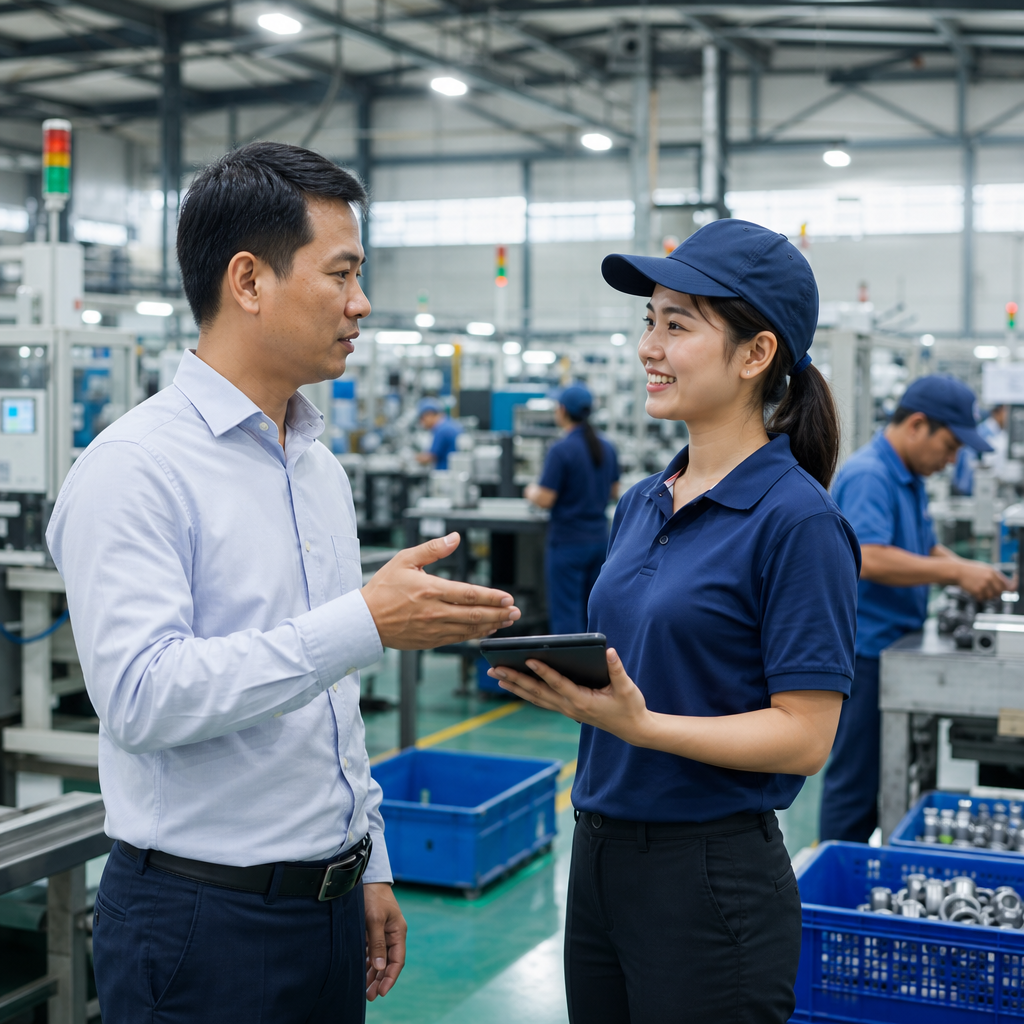
The client in this review arrived for a production-floor visit where machinery, staff movement, and scheduled demonstrations left little room for slow discussion. Questions had to be interpreted beside operating equipment, often while several factory representatives were moving between workstations. Clear communication depended on more than translating individual sentences.
From introductions to decisions
The visiting team needed to understand how the line operated and whether the supplier could meet practical requirements. The interpreter helped connect technical observations with business concerns, allowing both sides to discuss specifications, responsibilities, and follow-up actions without losing momentum. This is the core value of manufacturing visit support: keeping the conversation connected to decisions.
Question 1: Why is factory communication difficult during a site visit?
Factory communication is difficult because noise, technical vocabulary, unfamiliar processes, and time pressure can make otherwise simple questions unclear. Professional interpretation helps both teams hear the intended meaning and respond in the right operational context.
The production floor is not a meeting room
Factories create communication challenges that do not appear in a conference room. Machinery can interrupt speech, safety rules can limit where people stand, and demonstrations may move quickly from one station to another. Visitors may also be unfamiliar with local terms for materials, tooling, inspection, or production stages.
- Noise: Operating equipment can make short instructions or measurements difficult to hear accurately.
- Specialized language: Engineering and quality terms require context, not just word-for-word translation.
- Limited time: A scheduled tour may allow only brief opportunities to ask important questions.
Why context matters
In supplier discussions, a phrase about capacity might refer to installed equipment, current utilization, or a target output under specific conditions. Similarly, “quality check” may mean an in-process inspection or a final approval step. An experienced interpreter identifies these distinctions and helps participants clarify what a statement means before it affects a commercial decision.
Question 2: What did the interpreter clarify for the visiting team?
The interpreter clarified production details, answered questions about workflow and quality, and helped the visitors understand how the supplier’s process related to their requirements.
Turning observations into questions
Visitors often notice a machine, material, or inspection point but lack the Vietnamese terminology to ask about it precisely. During this visit, the interpreter helped connect what the client saw with focused questions for the factory team. That made the discussion more useful than a general tour and supported practical technical interpretation.
- Process flow: The team could ask where materials entered, changed, and moved to the next stage.
- Quality controls: Questions about inspection timing and responsibility became easier to direct.
- Production capability: The visitors could distinguish current output from potential capacity.
Keeping both sides aligned
Interpretation also supported the factory representatives, who could explain procedures in their preferred language rather than relying on incomplete English. This reduced the risk that a short answer would be mistaken for agreement. The interpreter’s role was not to make decisions, but to ensure the people making them were working from the same information.
Question 3: How were technical questions handled on the floor?
Technical questions were handled by interpreting them in context, checking unclear terminology, and confirming the factory’s response before the group moved to the next production area.
Clarifying specifications in real time
Technical interpretation is most effective when the interpreter understands the purpose behind a question. A request about tolerance, material grade, or testing may require a follow-up question about drawings, samples, or inspection standards. By slowing down the exchange at the right moment, the interpreter helped prevent assumptions from becoming apparent agreements.
- Terminology checks: Ambiguous words were clarified before the answer was accepted.
- Repeat-back: Important figures and requirements could be restated for confirmation.
- Practical context: Explanations were connected to the equipment and process being observed.
Supporting supplier communication
Supplier communication involves more than asking whether a factory can produce an item. Visitors may need to understand lead times, change-control procedures, documentation, packaging, and escalation points. The interpreter helped the client move from broad statements to specific discussion, giving both parties a clearer basis for evaluating the relationship.
Question 4: How did the interpreter confirm next steps?
The interpreter confirmed next steps by summarizing agreed actions, identifying responsible parties, and checking details such as documents, samples, timelines, and follow-up communication.
Ending with an actionable summary
A factory visit can feel successful while still producing an unclear follow-up. Before leaving, the client and supplier reviewed what each side needed to do next. This included confirming requested information, identifying materials to exchange, and making sure the timing discussed on the floor matched the expectations of the visiting team.
- Responsibilities: Each follow-up task was linked to a person or team.
- Deliverables: Documents, samples, or technical details were identified clearly.
- Timing: Proposed deadlines were repeated so they could be checked by both sides.
Reducing post-visit uncertainty
Clear confirmation matters because international teams may interpret polite or indirect language differently. A supplier’s willingness to “try” may not mean a firm commitment, while a visitor’s general interest may be understood as an order. The interpreter helped separate confirmed actions from open questions, improving the quality of the conversation after the visit.
Question 5: What can businesses learn from this factory visit?
Businesses can learn that professional interpretation should be treated as part of site-visit preparation, not as an emergency service added after communication problems appear.
Prepare around the visit objective
The most productive visits begin with a short briefing on the company, products, goals, and vocabulary likely to appear. Sharing drawings, schedules, supplier profiles, or question lists gives the interpreter useful context. For foreign visitors planning business travel Vietnam, this preparation can make a compact itinerary significantly more effective.
- Set priorities: Identify the three or four decisions the visit must support.
- Share terminology: Provide product names, measurements, process terms, and abbreviations in advance.
- Plan the debrief: Reserve time to summarize findings away from the machinery.
Choose support that fits the environment
A companion interpreter can assist before, during, and after a factory visit, including coordination at the gate, movement between departments, and discussion over a meal or office meeting. For clients seeking a factory interpreter Vietnam, ezgogo.app offers access to professional interpreter-companions who can support communication across a practical business itinerary.
Conclusion
The client’s experience shows why clear interpretation matters on a fast-moving production floor. A capable interpreter helped bridge language gaps, clarify technical questions, distinguish confirmed commitments from open points, and keep the supplier discussion connected to measurable next steps. For international teams, that clarity can improve both the visit itself and the decisions that follow.
Effective communication is a practical investment when evaluating Vietnamese suppliers, production partners, or manufacturing opportunities. If your next visit involves factories, technical meetings, or supplier negotiations, explore EZGOGO interpreter-companions through ezgogo.app for support tailored to your itinerary.
Sources
Frequently Asked Questions
Question 1: Why is factory communication difficult during a site visit?
Factory communication is difficult because noise, technical vocabulary, unfamiliar processes, and time pressure can make otherwise simple questions unclear. Professional interpretation helps both teams hear the intended meaning and respond in the right operational context.
Question 2: What did the interpreter clarify for the visiting team?
The interpreter clarified production details, answered questions about workflow and quality, and helped the visitors understand how the supplier’s process related to their requirements.
Question 3: How were technical questions handled on the floor?
Technical questions were handled by interpreting them in context, checking unclear terminology, and confirming the factory’s response before the group moved to the next production area.
Question 4: How did the interpreter confirm next steps?
The interpreter confirmed next steps by summarizing agreed actions, identifying responsible parties, and checking details such as documents, samples, timelines, and follow-up communication.
Question 5: What can businesses learn from this factory visit?
Businesses can learn that professional interpretation should be treated as part of site-visit preparation, not as an emergency service added after communication problems appear.
Need a local companion or interpreter in Vietnam?
Browse verified companions for language support, factory visits, and authentic local experiences.
Find a Companion →