 EZGOGO
Ho Chi Minh City Market Research: A Field Journal
A single day of Ho Chi Minh City market research can reveal more than a spreadsheet: pricing signals, competitor habits, shopper preferences, and the cultural context behind each answer. This field journal follows an international team through retail visits, informal interviews, and observations across one of Vietnam’s most commercially active cities. It also shows why a local research guide can help foreign teams move efficiently, ask better questions, and interpret what they see accurately. Read on for a practical view of Vietnam market visits and the role of interpreter-companions in turning field notes into useful business insight.
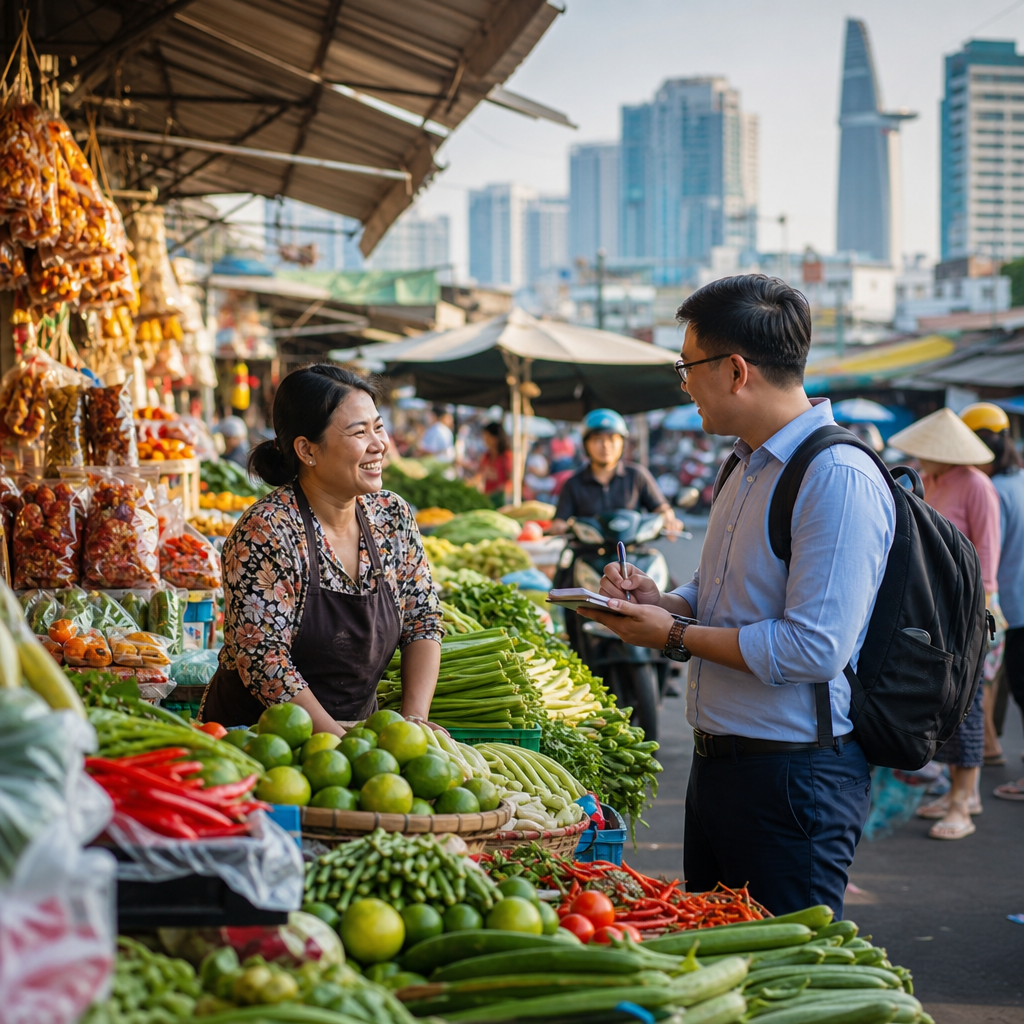
A Day in the Field
Before 8 a.m., the research team meets near central Ho Chi Minh City with a short list of stores, product categories, and interview objectives. The city is Vietnam’s largest economic center, with dense retail activity ranging from traditional markets and independent shops to convenience chains and modern malls. For an overseas team, the challenge is not simply seeing the market but understanding what each observation means.
The morning route is deliberately practical: visit several outlets, compare prices, note displays, and speak with people who sell or use the products. These Vietnam market visits produce stronger results when the team can move naturally through different settings rather than relying only on scheduled meetings. A local companion also helps explain etiquette, terminology, and business context as findings emerge.
From itinerary to evidence
A field journal turns scattered impressions into evidence. The team records shelf position, package sizes, promotions, customer traffic, and questions that require follow-up. Photographs and notes are useful, but they become more valuable when linked to location, time, and the local explanation behind a visible pattern.
Why context matters
Ho Chi Minh City combines fast-growing modern commerce with long-established neighborhood retail. A product may appear differently in a supermarket, a specialist store, and a street-facing shop because each channel serves a different customer and operating model. A local research guide helps visitors avoid treating one location as a complete picture of the market.
Question 1: Why start market research in Ho Chi Minh City?
Ho Chi Minh City is a strong starting point because it concentrates consumers, distributors, manufacturers, commercial services, and multiple retail formats in one major urban market. Its scale and variety allow foreign teams to compare channels quickly while building a grounded view of Vietnam’s business environment.
A concentrated commercial ecosystem
The city has long served as a gateway for domestic and international trade in southern Vietnam. General Statistics Office data regularly identifies Ho Chi Minh City as a major contributor to national economic activity, while the city’s ports, industrial links, and service economy connect field observations to wider supply chains. That combination makes local research relevant beyond the city itself.
- Retail variety: Traditional outlets, convenience stores, supermarkets, and specialty retailers can be compared within a manageable route.
- Business density: Importers, distributors, agencies, and service providers are easier to identify through local introductions.
- Consumer diversity: Different districts offer contrasting income levels, lifestyles, and shopping routines.
The value of a focused route
A productive route is narrower than a sightseeing itinerary. The team selects locations based on the research question, allowing repeated comparisons instead of collecting disconnected snapshots. With a companion who understands the city, visitors can reduce travel friction and spend more time observing products, conversations, and customer behavior.
Question 2: What can shop visits reveal?
Shop visits reveal how products are priced, positioned, explained, and purchased in real conditions. They can expose differences between a brand’s intended strategy and the way retailers actually present products to Vietnamese customers.
Reading the shelf
At each stop, the team checks more than whether a product is available. They compare package sizes, promotional mechanics, neighboring brands, staff recommendations, and the language used on labels or signs. These details can indicate whether a category competes on price, trust, convenience, origin, quality, or familiarity.
- Price structure: Record standard prices, discounts, bundles, and differences between outlets.
- Visibility: Note shelf height, display space, signage, and placement near competing products.
- Sales explanation: Listen for the benefits retailers emphasize when customers ask questions.
Comparing modern and traditional channels
Modern retail can provide consistent displays and formal promotions, while independent shops may reveal personal selling techniques and neighborhood trust. Neither channel should be treated as automatically more representative. A careful team compares the customer, location, and purchasing mission before drawing conclusions about demand.
Question 3: How do local interviews improve findings?
Local interviews improve findings by adding reasons and perspectives that observation alone cannot provide. Short, respectful conversations with retailers, staff, and consumers can clarify purchasing motivations, operational constraints, and the vocabulary people use in everyday business.
Asking better questions
Questions need to fit the setting. In a busy store, a concise conversation about fast-moving products may be more useful than a formal questionnaire. An interpreter-companion can help the team adjust tone, explain its purpose, and recognize when a question sounds too direct or assumes knowledge the respondent does not share.
- Use plain language: Avoid technical terms that may produce unclear or overly polite answers.
- Probe examples: Ask what happened during a recent sale rather than relying only on general opinions.
- Respect boundaries: Seek permission before recording, photographing, or discussing commercially sensitive details.
Capturing meaning, not just words
Direct translation is only one part of an interview. Meaning may depend on tone, hesitation, local categories, or a distinction between what someone says publicly and what they do in practice. A skilled local research guide can flag these nuances without replacing the respondent’s voice, helping the visiting team separate translation from interpretation.
Question 4: What role does retail interpretation play?
Retail interpretation connects language with commercial context. It helps foreign visitors understand product claims, customer questions, bargaining behavior, and retailer comments while keeping the conversation natural and accurate.
Beyond word-for-word translation
In a store, a translated phrase can still be misleading if its commercial meaning is unclear. Retail interpretation may involve explaining a local abbreviation, identifying a product category, or clarifying whether a promotion applies to all customers. The goal is not to dominate the conversation but to prevent small misunderstandings from distorting the research record.
During the afternoon route, the team uses an interpreter-companion to compare observations immediately. When one retailer describes a product as suitable for a particular household, the companion explains the social and practical assumptions behind that description. This kind of business traveler support makes field notes more precise while keeping the team moving.
Building trust in short encounters
Trust develops quickly when visitors follow local etiquette and show genuine interest. A companion can introduce the team appropriately, explain why questions are being asked, and advise when to pause or move on. These small interventions often create more comfortable conversations than a rigid script delivered through a remote translation service.
Question 5: How can teams organize a productive field day?
Teams can organize a productive field day by defining a small number of research questions, grouping locations geographically, scheduling realistic breaks, and reviewing findings before the day ends. The best plan combines preparation with enough flexibility to follow unexpected but relevant leads.
A practical field schedule
The team begins with a briefing, then visits a mix of planned outlets and leaves space for one or two opportunistic stops. Each visit has a time limit and a note-taking owner, while the interpreter-companion tracks local terminology and follow-up contacts. A short midday review prevents the group from repeating observations without noticing gaps.
- Define objectives: Choose the decisions the research should inform before selecting locations.
- Prepare a scorecard: Use consistent fields for price, availability, display, service, and customer response.
- Review nightly: Separate verified observations, assumptions, and questions requiring additional evidence.
Turning notes into next steps
At the end of the route, the team organizes findings by theme rather than by store alone. It identifies repeated signals, notable exceptions, and information still missing. For foreign companies planning entry, these conclusions can guide distributor discussions, product adaptation, pricing tests, or a second research trip focused on a narrower customer segment.
Conclusion
A day of Ho Chi Minh City market research is most useful when observation, conversation, and local context are treated as one process. Shop visits show what is happening, interviews suggest why, and careful interpretation helps international teams avoid reading familiar business questions through an unfamiliar cultural lens.
For the next Vietnam market visit, a prepared interpreter-companion can make the schedule more efficient and the findings more dependable. Explore ezgogo.app to connect with local professionals who can support retail visits, interviews, and business travel in Vietnam.
Sources
Frequently Asked Questions
Question 1: Why start market research in Ho Chi Minh City?
Ho Chi Minh City is a strong starting point because it concentrates consumers, distributors, manufacturers, commercial services, and multiple retail formats in one major urban market. Its scale and variety allow foreign teams to compare channels quickly while building a grounded view of Vietnam’s business environment.
Question 2: What can shop visits reveal?
Shop visits reveal how products are priced, positioned, explained, and purchased in real conditions. They can expose differences between a brand’s intended strategy and the way retailers actually present products to Vietnamese customers.
Question 3: How do local interviews improve findings?
Local interviews improve findings by adding reasons and perspectives that observation alone cannot provide. Short, respectful conversations with retailers, staff, and consumers can clarify purchasing motivations, operational constraints, and the vocabulary people use in everyday business.
Question 4: What role does retail interpretation play?
Retail interpretation connects language with commercial context. It helps foreign visitors understand product claims, customer questions, bargaining behavior, and retailer comments while keeping the conversation natural and accurate.
Question 5: How can teams organize a productive field day?
Teams can organize a productive field day by defining a small number of research questions, grouping locations geographically, scheduling realistic breaks, and reviewing findings before the day ends. The best plan combines preparation with enough flexibility to follow unexpected but relevant leads.
Need a local companion or interpreter in Vietnam?
Browse verified companions for language support, factory visits, and authentic local experiences.
Find a Companion →