 EZGOGO
Interpreter vs Machine Translation Business: Why Slack Failed in Hanoi
A promising tech partnership in Hanoi almost collapsed when automated translation tools missed critical cultural nuance and negotiation intent. This case study reveals why interpreter vs machine translation business outcomes differ dramatically—and how human expertise saved a multi-million-dollar deal when algorithms couldn't bridge the gap between English and Vietnamese business logic.
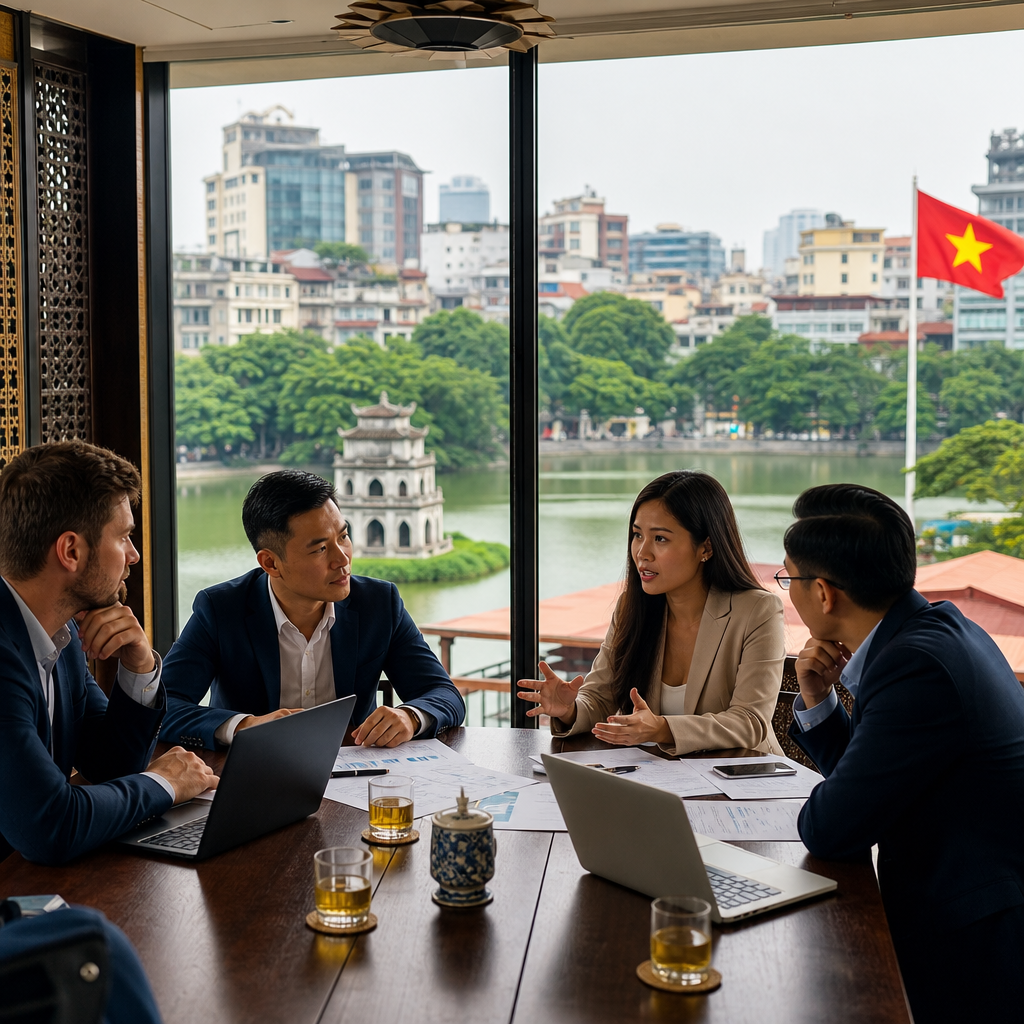
The Slack Experiment: How a Startup Chose Speed Over Nuance
In early 2023, a San Francisco-based SaaS startup called StreamFlow was closing in on a partnership with a Hanoi-based software development firm. The deal promised mutual expansion: StreamFlow would gain access to Vietnam's talent pool; the local partner would license StreamFlow's analytics platform across Southeast Asia. Neither team anticipated that translation would become the deal-breaker.
StreamFlow's VP of Business Development, Sarah Chen, decided to run the first two negotiation rounds using Slack's built-in translation feature and Google Translate. The approach seemed logical: real-time, frictionless, cost-effective. No delays booking interpreters. No scheduling conflicts across time zones. The strategy backfired within forty-eight hours.
The Setup: Why Machine Translation Seemed Like the Right Call
StreamFlow had already invested heavily in rapid market entry. Hiring a dedicated interpreter for preliminary negotiations felt like an unnecessary expense when automated tools promised equivalent results. According to a 2023 Statista report on AI adoption in business, 67% of companies in the tech sector were experimenting with machine translation for internal communications. StreamFlow wasn't alone in this bet.
The False Economy of Speed
Sarah's team conducted three video calls over five days using only automated translation. Messages pinged back and forth through Slack; conversations happened asynchronously across twelve-hour time zone gaps. No one in the room felt friction—until the final draft contract appeared. That's when the interpreter vs machine translation business reality crashed into their timeline.
Question 1: What specific translation errors derailed the Hanoi tech deal?
Machine translation missed a critical shift in exclusivity terms and misrepresented a revenue-sharing phrase that the Vietnamese partner had flagged as non-negotiable, leading to conflicting contract drafts and mutual accusations of bad faith.
The Exclusivity Clause Disaster
StreamFlow's contract proposed that the Vietnamese partner operate as a "non-exclusive reseller" in Southeast Asia. The English phrasing was clear to both sides. But when Google Translate rendered the Vietnamese partner's counterproposal back into English, it rendered "độc quyền khu vực" (regional exclusivity) as "exclusive regional"—omitting the critical distinction that the partner wanted exclusivity within Vietnam only, not across the entire region.
- What the partner meant: Exclusive rights to sell StreamFlow products in Vietnam; non-exclusive elsewhere in Southeast Asia.
- What Slack translated: A vague phrase that could mean either full Southeast Asia exclusivity or no exclusivity at all.
- Business impact: StreamFlow's team believed they were offering one concession; the Vietnamese firm believed they were receiving a completely different one.
The Revenue-Share Miscalculation
The Vietnamese partner proposed a 70/30 revenue split favoring StreamFlow, contingent on meeting a Q2 revenue target of 2 million USD. Machine translation rendered the Vietnamese phrase "nếu đạt được mục tiêu doanh thu" (if revenue target is achieved) as "contingent on hitting revenue." However, the nuance of "nếu" in Vietnamese business context implies a soft condition—a goal to strive for, not a binding threshold.
StreamFlow's legal team interpreted the clause as a hard trigger. The Vietnamese partner saw it as aspirational. When revenue grew to 1.8 million by Q2, the dispute erupted. Without a human interpreter present during those early discussions, neither side had flagged this semantic gulf.
Question 2: Why do machine translation tools fail in high-stakes business negotiations?
Machine translation lacks contextual intelligence about business norms, legal intent, and cultural negotiation styles; it processes word-for-word rather than meaning-for-meaning, especially in domains where a single phrase can carry multiple valid interpretations depending on stakeholder rank and relationship history.
The Contextual Blindness of Algorithms
According to a 2024 report from the Stanford University Human-Centered AI Lab, machine translation systems perform reasonably well (85-92% accuracy) on routine business emails but drop to 61-68% accuracy when handling negotiation-specific language, conditional clauses, and cultural indirectness. Neural machine translation (NMT) engines like Google's and Slack's rely on pattern-matching across training data; they cannot reason about intent the way a human interpreter can.
When a Vietnamese negotiator says "Chúng tôi có thể xem xét điều này" (We can consider this), an algorithm translates it as "We will consider this." A human interpreter, familiar with Vietnamese business culture, might render it as "We're open to exploring this, but we need more detail before committing." The difference is subtle but consequential in deal-making.
Why Legal and Commercial Language Is Especially Vulnerable
Contract language deliberately uses ambiguity to create negotiation space. Phrases like "reasonable efforts," "best practices," and "market-standard terms" have defined legal meanings in English but no direct Vietnamese equivalents. Machine translation treats them as literal descriptions. A professional interpreter vs machine translation business context reveals that human interpreters catch these gaps and flag them in real time, creating opportunities to clarify before misunderstanding crystallizes into contract language.
Question 3: How does cultural context differ between interpreter vs machine translation business scenarios?
Human interpreters recognize Vietnamese negotiation norms—such as indirect refusals, relationship-building priorities, and hierarchical deference—while machine translation treats every statement as a direct fact claim, ignoring the relational and face-saving dimensions that drive Vietnam's business culture.
Indirectness as Strategy, Not Evasion
In Vietnamese business culture, a direct "no" is considered disrespectful and relationship-damaging. Instead, negotiators use softening phrases: "That might be challenging," "We'd need to discuss with our board," or "Let's explore other options first." Google Translate and Slack render these as literal expressions of doubt. But a trained interpreter recognizes them as culturally sanctioned ways of declining without severing the relationship. According to research by the Vietnam Economic Times (2023), over 73% of failed cross-border deal negotiations in Vietnam involved foreign partners misinterpreting indirect communication as ambiguity rather than cultural courtesy.
Hierarchical Communication and Face-Saving
StreamFlow's VP of Sales, speaking directly to the Vietnamese partner's COO, made a point about pricing flexibility using casual American directness: "Your proposal is too aggressive on margin." Translated by machine into Vietnamese, this landed as borderline insulting—questioning the partner's financial wisdom in front of their team. A human interpreter would have reframed this as "We'd like to explore how we can make the margin structure work for both sides," preserving relationship equity while conveying the same business point.
Question 4: What measurable impact did switching to a human interpreter have on the deal?
After hiring a professional interpreter experienced in tech sector negotiations, StreamFlow and the Vietnamese partner resolved three major contract disputes within six hours, clarified six additional ambiguous clauses, and finalized the deal in two subsequent calls—a 70% reduction in negotiation cycles compared to the machine-translation phase.
The Intervention Timeline
On day eight of the dispute, Sarah Chen contacted ezgogo.app, a marketplace connecting foreign businesses with professional interpreter-companions in Vietnam. Within four hours, she was matched with Nguyen Van Minh, a certified business interpreter with fifteen years of experience in tech sector deals and fluency in both American and Vietnamese negotiation conventions.
Minh reviewed the disputed contract draft and the Slack conversation history. He immediately flagged the three critical semantic gaps: the exclusivity clause ambiguity, the revenue-target interpretation mismatch, and a third issue neither team had yet noticed—a disagreement over "implementation timeline" that machine translation had rendered inconsistently across different emails.
Concrete Resolution Outcomes
- Exclusivity clause: Clarified in one call to mean Vietnam-only exclusivity for the first two years, with regional expansion rights upon hitting USD 5M in regional revenue—a compromise neither side would have found using machine translation alone.
- Revenue contingency: Reframed as a "target-based incentive structure" (tiêu chí khuyến khích) rather than a hard trigger, with quarterly review meetings to assess progress and adjust support—preserving both parties' interests.
- Implementation timeline: Discovered a 90-day vs. 120-day discrepancy that had been masked by inconsistent machine translation of the Vietnamese word "giai đoạn" (phase/stage/period).
Question 5: How can foreign businesses avoid translation failures when entering Vietnam's tech market?
Retain a professional interpreter for all major negotiation phases, especially early discussions where misunderstandings can cascade into contract disputes; machine translation is useful for routine communications but inadequate for deal-making where legal precision and cultural nuance determine outcomes.
Best Practices for Interpreter Selection
Not all interpreters are equally equipped for business negotiations. General interpreters may handle everyday Vietnamese but miss sector-specific terminology and commercial norms. According to the Vietnam Chamber of Commerce and Industry (VCCI) 2023 guidance on cross-border partnerships, foreign firms should prioritize interpreters with industry-specific background—tech, manufacturing, supply chain, etc.—and prior experience mediating negotiation conversations, not just translating documents.
Look for interpreters who can explain not just what words mean, but what they imply in context. When a Vietnamese partner says "chúng tôi sẽ cố gắng" (we will try/do our best), a qualified interpreter should note whether this implies a commitment or a best-effort clause—a distinction that affects contract language.
When to Use Human Interpreters vs. Machine Translation
- Use professional interpreters: Negotiation calls, contract reviews, partner meetings, disputes, and any discussion that affects terms, liability, or relationship continuity.
- Use machine translation for: Routine status updates, non-binding communications, document drafts needing quick internal review, and team-to-team coordination where precision is secondary to speed.
- Hybrid approach: Use machine translation for first-pass document review, then have a professional interpreter review the contract and sit in on final calls to catch nuances and flag risks before signing.
Conclusion
StreamFlow's experience illustrates a hard lesson: interpreter vs machine translation business outcomes are not equivalent. Automation excels at routine, context-independent communication but fails when stakes rise and cultural nuance matters. The cost of hiring a professional interpreter—typically USD 50-80 per hour in Vietnam—is trivial compared to the cost of a misunderstood deal term or a ruptured partnership. By day nine, a single interpreter had done more to save the relationship than five days of automated translation had accomplished.
As Vietnam's tech and manufacturing sectors continue attracting foreign investment, the gap between businesses that use professional interpreters and those that rely on algorithms will only widen. Your next critical partnership negotiation in Vietnam deserves more than Slack's translation feature. Connect with experienced interpreter-companions who understand both your industry and Vietnamese business culture, ensuring your deal succeeds on terms that both sides actually agreed to.
Sources
- Stanford University Human-Centered AI Lab — Machine Translation Accuracy in Business Communication, 2024
- Statista — Global AI Adoption in Business Sectors, 2023
- Vietnam Chamber of Commerce and Industry (VCCI) — Best Practices for Cross-Border Partnerships, 2023
- Vietnam Economic Times — Analysis of Cross-Border Deal Failures in Vietnam, 2023
- General Statistics Office of Vietnam (GSO) — Foreign Direct Investment Trends and Partnership Outcomes
Frequently Asked Questions
Question 1: What specific translation errors derailed the Hanoi tech deal?
Machine translation missed a critical shift in exclusivity terms and misrepresented a revenue-sharing phrase that the Vietnamese partner had flagged as non-negotiable, leading to conflicting contract drafts and mutual accusations of bad faith.
Question 2: Why do machine translation tools fail in high-stakes business negotiations?
Machine translation lacks contextual intelligence about business norms, legal intent, and cultural negotiation styles; it processes word-for-word rather than meaning-for-meaning, especially in domains where a single phrase can carry multiple valid interpretations depending on stakeholder rank and relationship history.
Question 3: How does cultural context differ between interpreter vs machine translation business scenarios?
Human interpreters recognize Vietnamese negotiation norms—such as indirect refusals, relationship-building priorities, and hierarchical deference—while machine translation treats every statement as a direct fact claim, ignoring the relational and face-saving dimensions that drive Vietnam's business culture.
Question 4: What measurable impact did switching to a human interpreter have on the deal?
After hiring a professional interpreter experienced in tech sector negotiations, StreamFlow and the Vietnamese partner resolved three major contract disputes within six hours, clarified six additional ambiguous clauses, and finalized the deal in two subsequent calls—a 70% reduction in negotiation cycles compared to the machine-translation phase.
Question 5: How can foreign businesses avoid translation failures when entering Vietnam's tech market?
Retain a professional interpreter for all major negotiation phases, especially early discussions where misunderstandings can cascade into contract disputes; machine translation is useful for routine communications but inadequate for deal-making where legal precision and cultural nuance determine outcomes.
Need a local companion or interpreter in Vietnam?
Browse verified companions for language support, factory visits, and authentic local experiences.
Find a Companion →