 EZGOGO
Vietnam Business Lunch Communication: Avoid Miscommunication
A business lunch in Vietnam can open doors, but small misunderstandings around ordering, conversation, hospitality, or payment may affect trust. Vietnam business lunch communication requires more than translating words: visitors also need to read cultural cues and understand how relationships develop over a shared meal. This guide explains how to prepare, follow local dining etiquette, manage sensitive topics, and close the meeting professionally. It also shows when a local lunch meeting interpreter or companion can help international professionals communicate naturally while building stronger connections with Vietnamese partners.
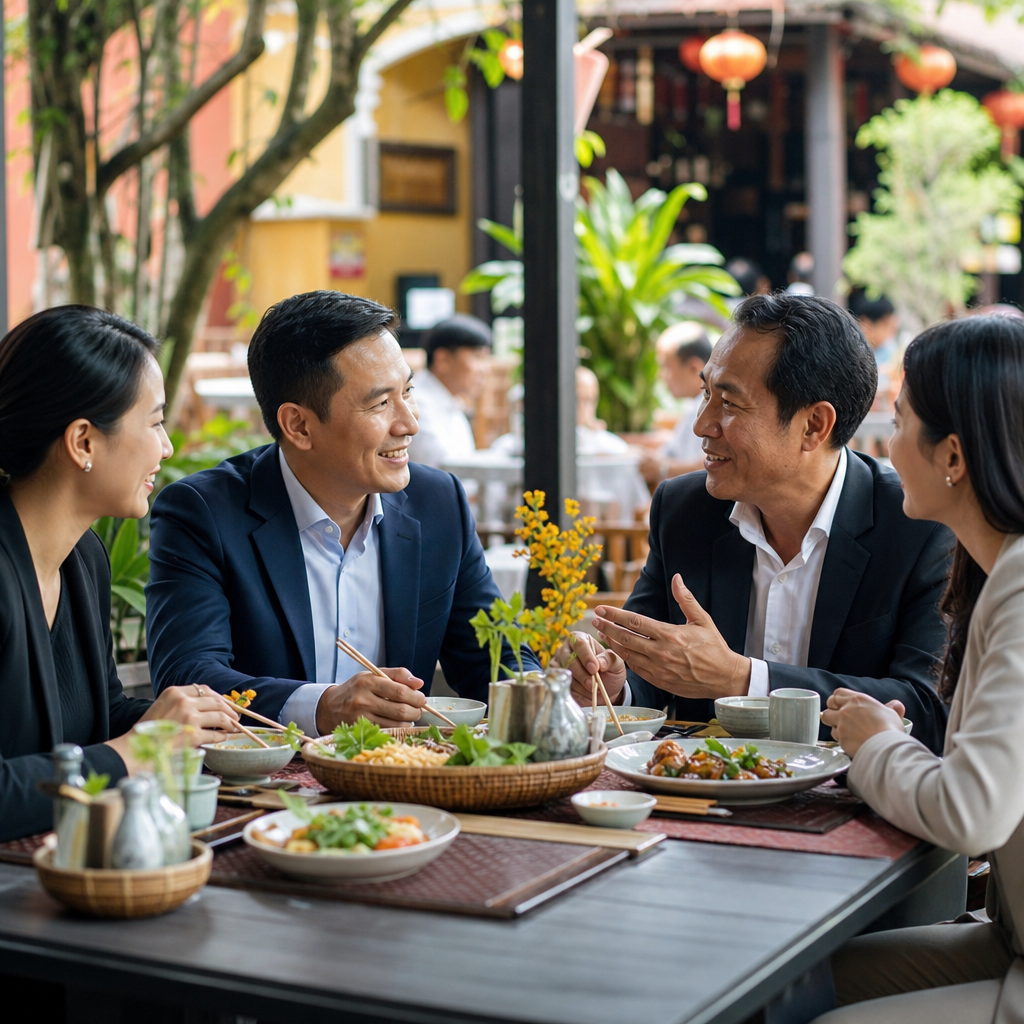
Building Trust Around the Table
Vietnam’s expanding manufacturing, trade, and tourism sectors bring more international professionals into local meetings. Business meals are often an important part of that activity because partners can assess reliability and personal fit outside the formal conference room. Vietnam business lunch communication therefore involves listening, observing, and building rapport as well as discussing commercial terms.
A successful lunch does not require visitors to imitate every local custom. It does require preparation for shared dishes, changing conversation topics, polite invitations to eat, and possible differences in communication style. Clear expectations before the meal can prevent confusion while leaving room for a natural relationship-building experience.
Why the meal matters in Vietnam
Vietnamese business relationships commonly develop through repeated contact and personal trust. A meal gives hosts and guests time to understand one another before negotiations become more detailed. The setting may be informal, but comments about hospitality, timing, and attentiveness can still influence how a potential partner views the meeting.
Preparation beyond the agenda
Review the company, attendees, dietary restrictions, and desired outcomes before arriving. It is also useful to learn a few Vietnamese greetings and confirm whether the meal will be at a restaurant, hotel, or private dining room. This preparation helps visitors focus on people and context instead of solving avoidable logistical problems.
Question 1: How should visitors prepare for a Vietnamese business lunch?
Visitors should confirm the venue, attendees, dietary needs, meeting purpose, and payment expectations in advance. They should also leave enough time for informal conversation rather than treating lunch as a compressed sales presentation.
Set expectations before arrival
Send a concise message confirming the date, time, location, and names of participants. If the group includes senior executives or technical specialists, clarify their roles so introductions are smooth. A short agenda can help, but avoid implying that every minute must be dedicated to presentations or contract discussion.
- Dietary needs: Explain allergies, religious restrictions, and preferences clearly before dishes are ordered.
- Business goal: Identify whether the lunch is for introductions, supplier evaluation, negotiation, or relationship building.
- Timing: Allow space for traffic, ordering, informal conversation, and a gradual close.
Prepare practical language
Write down essential product names, quantities, prices, delivery terms, and technical questions in simple language. Avoid relying on idioms, jokes, or long sentences that may be difficult to interpret. If important decisions are expected, prepare a written summary that can be reviewed after the meal rather than forcing precision in a noisy restaurant.
Question 2: What dining etiquette prevents misunderstandings?
Follow the host’s lead on seating, ordering, serving, toasting, and payment while remaining politely clear about allergies or limits. Shared dishes and invitations to eat are usually signs of hospitality, not automatic agreement with a business proposal.
Understand shared-dish customs
Vietnamese meals often feature several dishes placed in the center for everyone to share. Hosts may encourage guests to try particular foods or add food to a guest’s bowl as a gesture of care. Accepting a small portion is usually courteous, but guests can decline calmly when necessary and explain the reason without criticizing the cuisine.
- Use serving utensils: Follow the restaurant’s arrangement and observe how others transfer food.
- Try modest portions: A small taste shows openness without creating pressure to finish unfamiliar dishes.
- Respect invitations: Thank the host even when you cannot accept another serving or drink.
Separate hospitality from commitment
A warm meal, toast, or encouraging comment should not be recorded as a confirmed order, investment, or contract term. Restate important points gently after the meal, preferably in writing. Good business dining etiquette protects both sides because it recognizes the social value of hospitality while keeping commercial decisions precise.
Question 3: How can guests manage conversation and translation?
Guests should use short statements, pause regularly, and confirm important points instead of assuming that polite agreement means full understanding. A professional lunch meeting interpreter can preserve meaning, tone, and turn-taking without taking over the relationship.
Make interpretation easier
Speak to the Vietnamese participant rather than addressing the interpreter as the main conversation partner. Deliver one idea at a time, avoid unexplained acronyms, and pause after each thought. If several people speak at once, ask the group to slow down so the interpreter can capture the speaker’s intent and the appropriate level of formality.
- Use plain language: Replace idioms and jokes with direct wording when discussing business matters.
- Check meaning: Ask for a brief recap of dates, quantities, responsibilities, and next steps.
- Protect confidentiality: Share sensitive documents and instructions only with trusted, professional language support.
Handle disagreement constructively
Vietnamese cultural cues may make disagreement less direct than some foreign visitors expect. A pause, softened answer, or suggestion to discuss something later may signal uncertainty rather than acceptance. Keep your tone calm and ask open questions such as, “What would work best for your team?” This invites clarification without publicly pressuring a partner.
Question 4: Which cultural cues matter during the meal?
Pay attention to hierarchy, introductions, tone, silence, and the host’s invitations, but avoid treating any single gesture as a fixed rule. Cultural cues provide context; they should be checked through respectful questions before visitors draw conclusions about interest or agreement.
Read hierarchy and introductions
Participants may expect senior representatives to guide the opening, seating, or toast. Introduce people with their roles and pronounce names carefully, then allow the host to establish the flow. Showing respect to senior attendees does not mean ignoring junior colleagues; technical staff may hold crucial knowledge about production, quality, or implementation.
Keep sensitive topics in perspective
Personal questions about family, hometown, education, or travel may appear during relationship-building conversation. Respond at a comfortable level and redirect toward shared interests when needed. Avoid criticizing local food, comparing salaries, or making political claims without understanding the setting. Humor should be inclusive, especially when language proficiency varies across the table.
Question 5: How should visitors follow up after lunch?
Send a short thank-you message and a written summary of agreed actions within one business day. Separate confirmed decisions from open questions, assign owners and deadlines, and invite corrections so any translation or cultural misunderstanding can be resolved quickly.
Document the next steps
Thank the host for the time and hospitality, then list the practical outcomes in clear language. Include product specifications, requested documents, meeting dates, sample requirements, or site-visit plans only when they were genuinely discussed. If a point remains uncertain, label it as pending rather than presenting an assumption as a commitment.
- Confirmed: Record decisions that all relevant participants explicitly accepted.
- Pending: Identify questions requiring internal review, pricing checks, or technical validation.
- Responsible person: Name the contact who will provide each document or action.
Continue the relationship
Follow-up should maintain the human connection as well as advance the transaction. Share a useful update, acknowledge a local holiday when appropriate, or suggest a focused second meeting. Consistent, respectful communication signals that the lunch was part of a longer partnership rather than a one-time attempt to secure an immediate concession.
Conclusion
Strong Vietnam business lunch communication combines preparation, patient listening, respectful dining behavior, and written confirmation. Visitors who understand shared meals, hierarchy, indirect signals, and the difference between hospitality and agreement are better equipped to build trust without losing commercial clarity.
For complex discussions or first meetings, a local interpreter-companion can help with language, context, ordering, and follow-up while keeping the conversation natural. Explore EZGOGO at ezgogo.app to find support for your next Vietnam business trip.
Sources
Frequently Asked Questions
Question 1: How should visitors prepare for a Vietnamese business lunch?
Visitors should confirm the venue, attendees, dietary needs, meeting purpose, and payment expectations in advance. They should also leave enough time for informal conversation rather than treating lunch as a compressed sales presentation.
Question 2: What dining etiquette prevents misunderstandings?
Follow the host’s lead on seating, ordering, serving, toasting, and payment while remaining politely clear about allergies or limits. Shared dishes and invitations to eat are usually signs of hospitality, not automatic agreement with a business proposal.
Question 3: How can guests manage conversation and translation?
Guests should use short statements, pause regularly, and confirm important points instead of assuming that polite agreement means full understanding. A professional lunch meeting interpreter can preserve meaning, tone, and turn-taking without taking over the relationship.
Question 4: Which cultural cues matter during the meal?
Pay attention to hierarchy, introductions, tone, silence, and the host’s invitations, but avoid treating any single gesture as a fixed rule. Cultural cues provide context; they should be checked through respectful questions before visitors draw conclusions about interest or agreement.
Question 5: How should visitors follow up after lunch?
Send a short thank-you message and a written summary of agreed actions within one business day. Separate confirmed decisions from open questions, assign owners and deadlines, and invite corrections so any translation or cultural misunderstanding can be resolved quickly.
Need a local companion or interpreter in Vietnam?
Browse verified companions for language support, factory visits, and authentic local experiences.
Find a Companion →